
Introduction
A wall-mounted home battery is one of the most practical ways to store energy for backup power, solar self-consumption, and daily household energy management. But one common question often comes up before purchase:
Does a wall-mounted home battery include an inverter?
In most cases, the answer is no. A wall-mounted home battery usually stores electricity as DC power, while most home appliances use AC power. To make that stored energy usable for your home, the battery typically needs to work with a compatible inverter.
However, not every product is designed the same way. Some systems are sold as all-in-one energy storage units with a built-in inverter, while others are battery-only products that must be paired with an external inverter. Understanding the difference can help you avoid compatibility problems and choose the right setup for your home.
What Is a Wall-Mounted Home Battery?
A wall-mounted home battery is a rechargeable energy storage unit designed to be installed on a wall, usually in a garage, utility room, basement, or energy storage area. It stores electricity from solar panels, the grid, or another power source, depending on the system design.
Most lithium home batteries are built around battery cells, a battery management system, communication ports, and protective housing. Their main job is to store and release DC electricity safely.
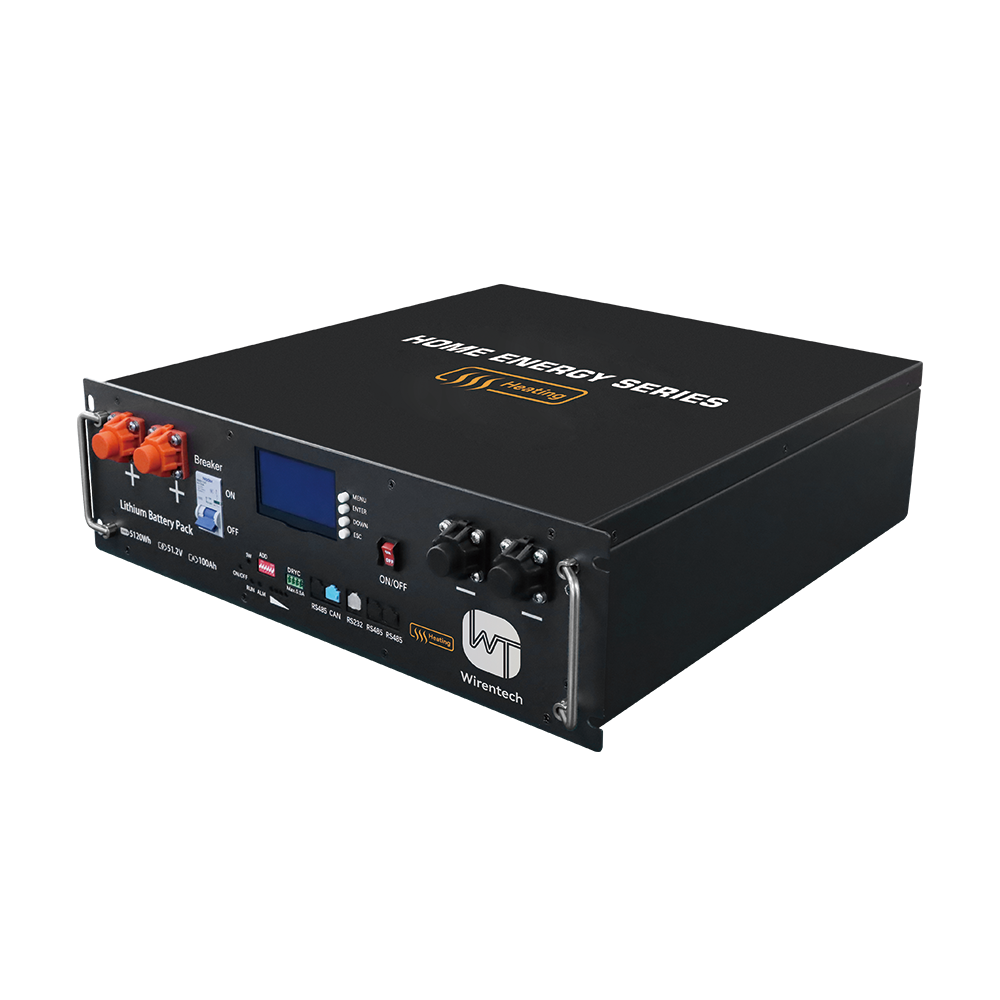
For example, the Wirentech Powerwall is listed as a 51.2V 314Ah, 16kWh lithium battery module. Its specification sheet shows battery-focused parameters such as operation voltage, charge and discharge current, cycle life, enclosure protection, and communication options. The spec sheet lists CAN/RS485 communication to inverters, which indicates that the battery is designed to communicate with compatible external inverter equipment rather than being described as an inverter-integrated device.
That distinction is important. A home battery and an inverter are related, but they are not the same component.
What Does an Inverter Do in a Home Battery System?

An inverter converts electricity between DC and AC power.
A battery stores energy as DC power. Your home appliances, outlets, lighting, refrigerator, Wi-Fi router, and most household loads use AC power. The inverter bridges that gap.
In a home energy storage system, the inverter may perform several key functions:
- Convert battery DC power into usable AC power for the home
- Manage solar power input, depending on inverter type
- Control charging and discharging behavior
- Communicate with the battery’s BMS
- Support backup power operation when properly configured
- Coordinate grid, solar, battery, and load power flow
Without an inverter, a typical home battery cannot directly power standard household AC appliances.
Does the Battery Itself Include the Inverter?

Usually, a wall-mounted battery does not include an inverter unless the product clearly says it does.
There are two common types of home energy storage products:
Battery-Only Wall-Mounted Units
These are batteries designed to work with compatible inverters. They usually include battery cells, a BMS, protection systems, communication ports, and housing, but not the inverter itself.
This type of battery gives installers and homeowners more flexibility because the battery can be paired with different inverter systems, depending on compatibility. However, it also means you must confirm that the inverter and battery can work together before installation.
Important compatibility points include voltage range, charge and discharge current, communication protocol, inverter settings, and system design.
All-in-One Home Energy Storage Systems
Some systems combine the battery and inverter in one cabinet or enclosure. These are often marketed as “all-in-one ESS,” “hybrid inverter battery system,” or “integrated home energy storage system.”
An all-in-one unit can simplify system design, but it may offer less flexibility in battery expansion or inverter selection. It is also important to check whether the built-in inverter capacity matches your backup power needs.
How to Tell If a Wall Battery Includes an Inverter

The easiest way is to look at the product description and specification sheet. A battery with a built-in inverter will usually state that clearly.
Look for phrases such as:
“Built-in inverter”
“Integrated inverter”
“All-in-one energy storage system”
“Hybrid inverter included”
“AC output”
If the specification sheet mainly lists battery voltage, capacity, BMS parameters, charge current, discharge current, and inverter communication ports, it is likely a battery module that needs an external inverter.
For example, our Powerwall specification sheet lists communication as RS232/RS485 to PC software and CAN/RS485 to inverters, along with battery specifications such as 51.2V 314Ah capacity, 16kWh energy, 44.8V–57.5V operation voltage, and IP65 enclosure protection. These are battery module specifications, not built-in inverter specifications.
Why Inverter Compatibility Matters
Choosing a home battery is not only about capacity. Even if a battery has enough energy storage, it still needs to work properly with the inverter.
Voltage Compatibility
The inverter must support the battery’s voltage range. For a 51.2V lithium battery system, the inverter must be designed to work with that voltage class and charging profile.
Communication Compatibility
Many modern lithium batteries use communication protocols such as CAN or RS485. These allow the battery BMS and inverter to exchange information about state of charge, voltage, current limits, alarms, and protection status.
If communication is not supported or configured correctly, the system may not charge or discharge as expected.
Power Output Requirements
Battery capacity is measured in kWh, while inverter output is often measured in kW. These are related but different.
A 16kWh battery tells you how much energy is stored. The inverter rating helps determine how much power can be delivered at one time. For backup power, you need to consider both.
For example, a small backup load such as internet equipment, lighting, and a refrigerator may require a different inverter setup than a whole-home backup system with HVAC, well pump, or large appliances.
Battery Capacity vs. Inverter Size
Many buyers confuse battery capacity with inverter power. This can lead to unrealistic expectations.
A battery’s kWh rating tells you how much energy it can store. An inverter’s kW rating tells you how much power it can deliver at once.
For example:
A battery may store enough energy to run essential loads for several hours, but if the inverter is too small, it may not start or support high-power appliances. On the other hand, a large inverter paired with a small battery may drain the battery quickly.
The best system depends on your goals:
For Backup Power
Focus on essential loads, outage duration, inverter surge capability, and battery capacity.
For Solar Self-Consumption
Focus on daily energy use, solar production, usable storage capacity, and inverter compatibility.
For Expandable Home Energy Storage
Focus on parallel battery support, cabinet or wall space, communication setup, and long-term system design.
[Image suggestion: comparison chart showing battery capacity in kWh vs inverter output in kW]
What to Ask Before Buying a Wall-Mounted Home Battery
Before choosing a wall-mounted battery, ask these practical questions:
- Does this product include an inverter, or is it battery-only?
- Which inverter brands or models are compatible?
- Does the inverter support the battery voltage range?
- Does the battery communicate through CAN, RS485, or another protocol?
- Is the system intended for backup power, solar storage, or both?
- How many batteries can be connected in parallel?
- What installation requirements apply in your area?
- Does the battery location meet the product’s enclosure and environmental requirements?
For a product like the Wirentech Powerwall, buyers should treat it as a battery module and verify inverter compatibility before installation. The spec sheet provides key battery details, including 51.2V nominal configuration, 16kWh energy, 6000+ cycle life, 10-year warranty, and CAN/RS485 communication to inverters.
Common Misunderstandings About Wall-Mounted Batteries
“If It Stores Power, It Can Power My House Directly”
Not necessarily. A battery stores DC electricity. Your home usually needs AC electricity. The inverter makes that conversion possible.
“Any Inverter Can Work With Any Lithium Battery”
This is not safe to assume. Voltage, current limits, charging parameters, and communication protocols must be compatible.
“A Bigger Battery Means More Instant Power”
Not always. A larger battery may provide more stored energy, but instant power output depends on both the battery’s discharge capability and the inverter’s output rating.
“All Home Batteries Are Solar Batteries”
A home battery can be used in a solar system, but solar compatibility depends on the inverter, charge controller, system wiring, and installation design.
Conclusion
A wall-mounted home battery does not usually include an inverter. Most wall-mounted lithium batteries are battery modules that store DC electricity and must be paired with a compatible inverter to power household AC loads.
Some products are sold as all-in-one systems with a built-in inverter, but this should always be confirmed in the product specification sheet. Look for clear wording such as “built-in inverter,” “integrated inverter,” or “all-in-one energy storage system.”
For battery-only systems, the most important step is checking compatibility. Voltage range, communication protocol, charge and discharge limits, and installation requirements all matter. A well-matched battery and inverter setup can provide reliable backup power, better solar energy use, and a more flexible home energy storage system.




Share:
How Battery Energy Storage Supports AI Data Centers in 2026