
When building a whole house solar + battery system, the inverter is the part that decides how much real power your home can use at one time.
For many homeowners, the decision comes down to two popular options:
👉 10kW hybrid inverter
👉 12kW hybrid inverter
Both can support residential backup power, solar charging, and LiFePO4 battery storage. But they are not designed for the exact same type of home.
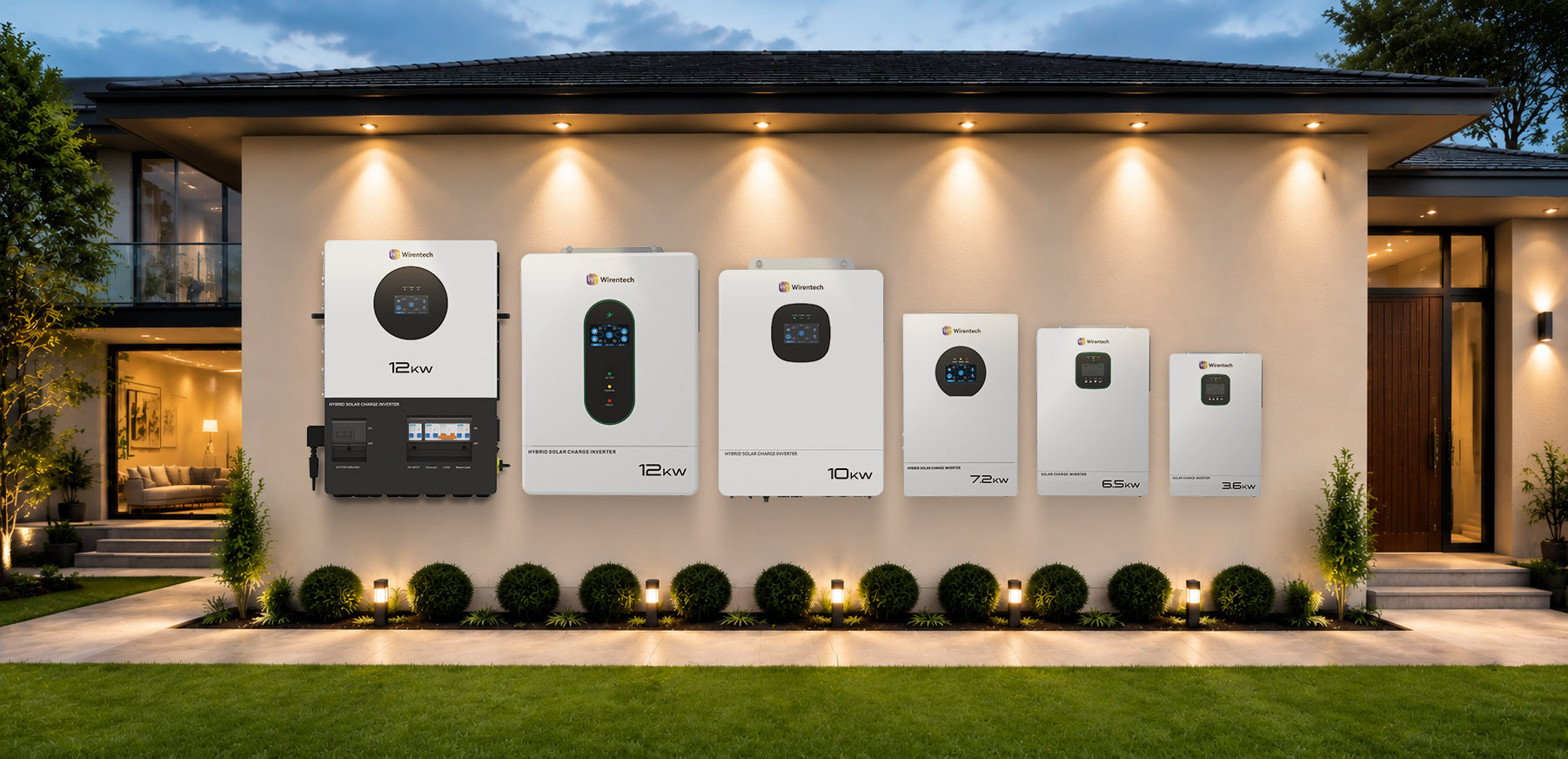
If you are still comparing inverter sizes from 3.6kW to 12kW, start with our full hybrid inverter sizing guide first.
Quick Answer: 10kW or 12kW?
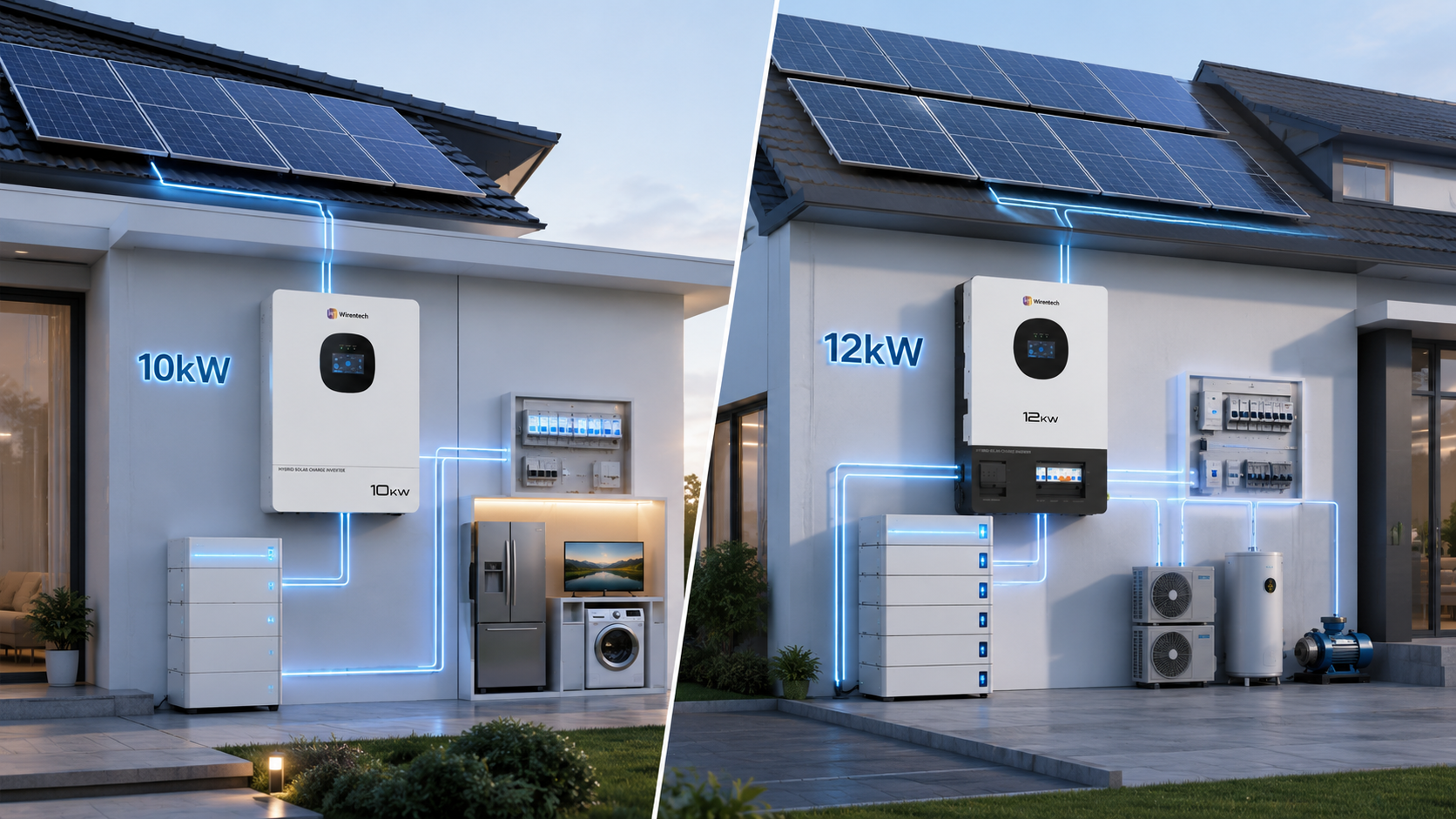
Choose a 10kW inverter if your home needs reliable whole-house backup for standard appliances, lighting, refrigerator, kitchen loads, one to two air conditioners, and a medium battery bank.
Choose a 12kW inverter if your home has multiple air conditioners, pumps, compressors, large kitchen equipment, or higher startup surge loads.
Primary Recommendation
👉 Best Fit for Most Homes: 10kW Hybrid Inverter
It gives enough power for most residential solar storage systems while keeping battery cost, PV size, and installation complexity under control.
Alternative for Heavy Loads
👉 Choose 12kW only when your home has higher peak load or larger expansion plans.
10kW vs 12kW Inverter Comparison Table
| Feature | 10kW Hybrid Inverter | 12kW Hybrid Inverter |
|---|---|---|
| Best For | Standard whole-house backup | Large homes / heavy-load backup |
| Rated Output Power | 10,000W split phase | 12,000W split phase |
| Peak Power | 15,000VA split phase | 18,000VA split phase |
| Motor Load Capability | 5HP | 6HP |
| Battery Voltage | 51.2V | 51.2V |
| Typical Battery Bank | 10–20kWh | 15–30kWh+ |
| Solar Array Match | 8–12kW PV | 10–15kW PV |
| Expansion Ability | Strong | Higher |
| Best Decision | Most homes | Large homes with surge loads |
According to the 10kW inverter manual, the GES48100 series supports 10,000W split-phase rated output, 15,000VA split-phase peak power, and 5HP loaded motor capability.
The 12kW GES48120 series increases rated split-phase output to 12,000W, peak power to 18,000VA, and loaded motor capability to 6HP.
10kW Hybrid Inverter: Best for Most Whole House Systems
A 10kW inverter is the best balance point for most home solar storage systems.
It is strong enough to support common whole-house backup loads without forcing the user into an oversized battery bank.
Choose 10kW If You Run:
- Refrigerator
- Lights
- TV and home electronics
- WiFi and office equipment
- Washing machine
- Kitchen appliances
- One to two air conditioners
- Small water pump
Best System Match
A 10kW whole house system usually pairs well with:
- 51.2V LiFePO4 battery system
- 10–20kWh battery bank
- 8–12kW solar panel array
- Rack-mounted or wall-mounted battery storage
Why 10kW Is the Default Recommendation
A 10kW inverter gives enough output for most residential systems while keeping the full system easier to size.
It avoids three common problems:
- Overspending on unnecessary inverter capacity
- Undersizing the battery bank
- Installing a PV array that is too small for the inverter
👉 For most homes, 10kW is the best fit.
12kW Hybrid Inverter: Best for Large Homes and Heavy Loads
A 12kW inverter is designed for homes that need more power headroom.
The main reason to choose 12kW is not daily energy use. It is peak load.
Large homes often have several appliances starting at the same time. Air conditioners, pumps, compressors, and motors can create short but high startup demand.
Choose 12kW If You Run:
- Multiple air conditioners
- Water pumps
- Pool pumps
- Compressors
- Large kitchen appliances
- Workshop equipment
- Multiple high-power loads at the same time
Best System Match
A 12kW system usually needs:
- 51.2V LiFePO4 battery bank
- 15–30kWh+ battery storage
- 10–15kW solar panel array
- Rack-mounted battery system
- Future parallel expansion planning
Why 12kW Is Not Always the Best Default
A 12kW inverter gives more headroom, but it also requires a stronger battery bank and larger system design.
If the battery bank is too small, the inverter rating will not deliver full real-world value.
👉 Choose 12kW only when the home has a clear high-load requirement.
Battery Matching: 10kW vs 12kW
Battery sizing is the part many users underestimate.
A larger inverter can pull more current from the battery bank. That means the battery system must be sized for both energy capacity and discharge capability.
| Inverter Size | Recommended Battery Setup |
|---|---|
| 10kW | 51.2V, 10–20kWh LiFePO4 battery bank |
| 12kW | 51.2V, 15–30kWh+ LiFePO4 battery bank |
Both manuals list 51.2V as the rated battery input voltage, with a minimum starting voltage of 44V.
Decision Rule
- If your battery bank is below 10kWh → choose 10kW after confirming load.
- If your battery bank is 15kWh or larger and your home has heavy loads → choose 12kW.
- If you plan future expansion → choose 12kW only when your battery and PV system will expand together.
Solar Panel Matching: 10kW vs 12kW
A whole house inverter should not be selected alone. It must match the solar array.
| Inverter Size | Recommended Solar Array |
|---|---|
| 10kW | 8–12kW PV |
| 12kW | 10–15kW PV |
Both 10kW and 12kW inverter manuals specify a maximum PV array open-circuit voltage of 500Vdc, 120Vdc startup voltage, and 90–450Vdc MPPT voltage range.
Practical Rule
A 12kW inverter should not be paired with a small solar array unless the main goal is backup power from battery or grid charging.
For solar-first systems, the PV array must be large enough to recharge the battery bank efficiently during the day.
Surge Load: The Real Difference Between 10kW and 12kW
Many homeowners choose inverter size based only on rated power. That is the wrong method.
The better method is to check:
- Running watts
- Startup watts
- Motor loads
- Air conditioner startup behavior
- Whether multiple appliances start together
The 10kW inverter provides 15,000VA peak power, while the 12kW model provides 18,000VA peak power. That extra surge capacity is the main reason to choose 12kW.
Who Should Choose a 10kW Inverter?
Choose 10kW if:
- Your home has standard residential loads
- You want whole-house backup without oversizing
- You run one to two air conditioners
- Your battery bank is around 10–20kWh
- Your solar array is around 8–12kW
- You want the best cost-to-performance balance
10kW Decision Split
👉 10kW is the correct choice for most residential whole-house systems.
Who Should Choose a 12kW Inverter?
Choose 12kW if:
- Your home has multiple AC units
- You use pumps, compressors, or motor loads
- Your peak load exceeds what a 10kW system should handle
- Your battery bank is 15–30kWh+
- Your solar array is 10–15kW
- You want more headroom for future expansion
12kW Decision Split
👉 12kW is the correct choice for heavy-load homes, not standard homes.
Common Mistakes When Choosing Between 10kW and 12kW
Mistake 1: Choosing 12kW only because it sounds stronger
A larger inverter is only useful when your battery, solar array, and load profile support it.
Mistake 2: Ignoring startup surge
Air conditioners, pumps, and compressors can require much higher startup power than their running power.
Mistake 3: Using too small a battery bank
A 12kW inverter with an undersized battery bank creates a weak system.
Mistake 4: Not planning AC load priority
Large loads should be managed properly to avoid overload or unstable operation.
The inverter manual also notes that appliances such as air conditioners need 2–3 minutes before restart to protect the compressor system.
Final Recommendation
Best Fit: 10kW Hybrid Inverter
For most whole-house solar backup systems, choose the 10kW hybrid inverter.
It is the best balance of:
- Power output
- Battery cost
- Solar panel matching
- System stability
- Long-term value
Alternative: 12kW Hybrid Inverter
Choose the 12kW hybrid inverter only when your home has:
- Multiple AC units
- Pumps or compressors
- Larger battery bank
- Higher peak load
- Expansion plan
👉 Decision Split:
For standard homes, choose 10kW.
For large homes with heavy loads, choose 12kW.
![[Pre-Order] Wirentech 12kW Hybrid Solar Inverter with Bypass for Home Energy Storage](http://wirentechshop.com/cdn/shop/files/12bp_bdcf00b1-989c-4581-bd54-0974ab610f28.png?v=1788318623&width=2000)
![[Pre-Order] Wirentech 12kW Hybrid Solar Inverter with Bypass for Home Energy Storage](http://wirentechshop.com/cdn/shop/files/G01-purchase-overview-2000x2000_239b36c9-5789-4dde-ac70-4fa1f1710694.jpg?v=1788855790&width=2000)
![[Pre-Order] Wirentech 12kW Hybrid Solar Inverter with Bypass for Home Energy Storage](http://wirentechshop.com/cdn/shop/files/G02-application-fit-2000x2000_ed7587c3-7052-442c-8988-58b2b01e63c2.jpg?v=1788855790&width=2000)
![[Pre-Order] Wirentech 12kW Hybrid Solar Inverter with Bypass for Home Energy Storage](http://wirentechshop.com/cdn/shop/files/G03-solar-input-2000x2000_767280a4-e107-4dfe-9ecf-ae5577ec7c7c.jpg?v=1788855790&width=2000)
![[Pre-Order] Wirentech 12kW Hybrid Solar Inverter for Home Energy Storage](http://wirentechshop.com/cdn/shop/files/12_7b9f9dd0-adc7-40e7-837c-da61a2ca8a88.png?v=1788318594&width=2000)
![[Pre-Order] Wirentech 12kW Hybrid Solar Inverter for Home Energy Storage](http://wirentechshop.com/cdn/shop/files/G01-purchase-overview-2000x2000_7ba85188-14db-447d-9094-27b199e22b26.jpg?v=1788855751&width=2000)
![[Pre-Order] Wirentech 12kW Hybrid Solar Inverter for Home Energy Storage](http://wirentechshop.com/cdn/shop/files/G02-application-fit-2000x2000_a78695a8-cba3-4575-8b42-e3d81645f514.jpg?v=1788855751&width=2000)
![[Pre-Order] Wirentech 12kW Hybrid Solar Inverter for Home Energy Storage](http://wirentechshop.com/cdn/shop/files/G03-solar-input-2000x2000_8d11c3fa-570d-483b-84b2-0ea793b826c8.jpg?v=1788855751&width=2000)
![[Pre-Order] Wirentech 10kW Hybrid Solar Inverter for Home Energy Storage](http://wirentechshop.com/cdn/shop/files/10_4135f980-1c5c-429c-9fcc-616d625ec181.png?v=1788318449&width=2000)
![[Pre-Order] Wirentech 10kW Hybrid Solar Inverter for Home Energy Storage](http://wirentechshop.com/cdn/shop/files/G01-purchase-overview-2000x2000_c2b3349c-17bb-4e92-889b-94fd75f1aadf.jpg?v=1788855685&width=2000)
![[Pre-Order] Wirentech 10kW Hybrid Solar Inverter for Home Energy Storage](http://wirentechshop.com/cdn/shop/files/G02-application-fit-2000x2000_54534a02-d110-475f-a832-f6a6f2eb80f6.jpg?v=1788855685&width=2000)
![[Pre-Order] Wirentech 10kW Hybrid Solar Inverter for Home Energy Storage](http://wirentechshop.com/cdn/shop/files/G03-solar-input-2000x2000_1aaeb226-d4f8-427d-9270-8fa54a057f7e.jpg?v=1788855685&width=2000)
![[Pre-Order] Wirentech 7.2kW Hybrid Solar Inverter for Home Energy Storage](http://wirentechshop.com/cdn/shop/files/7.2_31200f7d-32c3-48d5-9f81-d39e590df0d6.png?v=1788319219&width=2000)
![[Pre-Order] Wirentech 7.2kW Hybrid Solar Inverter for Home Energy Storage](http://wirentechshop.com/cdn/shop/files/G01-purchase-overview-2000x2000_57c762fe-c8d5-484d-8eb6-c51920f890b6.jpg?v=1788855850&width=2000)
![[Pre-Order] Wirentech 7.2kW Hybrid Solar Inverter for Home Energy Storage](http://wirentechshop.com/cdn/shop/files/G02-application-fit-2000x2000_92a70697-29ad-48cf-8468-540bbcea28d6.jpg?v=1788855851&width=2000)
![[Pre-Order] Wirentech 7.2kW Hybrid Solar Inverter for Home Energy Storage](http://wirentechshop.com/cdn/shop/files/G03-solar-input-2000x2000_a1b313e8-97b5-46b6-a3db-c2f3bd7ef4e4.jpg?v=1788855851&width=2000)
![[Pre-Order] Wirentech 6.5kW Hybrid Solar Inverter for Home Energy Storage](http://wirentechshop.com/cdn/shop/files/6.5_0d43453b-0cff-41ef-be64-d82ee7284ed7.png?v=1788318269&width=2000)
![[Pre-Order] Wirentech 6.5kW Hybrid Solar Inverter for Home Energy Storage](http://wirentechshop.com/cdn/shop/files/G01-purchase-overview-2000x2000_00e09918-c4a1-459e-8076-cd2cdead0fd1.jpg?v=1788855649&width=2000)
![[Pre-Order] Wirentech 6.5kW Hybrid Solar Inverter for Home Energy Storage](http://wirentechshop.com/cdn/shop/files/G02-application-fit-2000x2000_fa0155a6-46ac-41eb-b1a0-917a38228d85.jpg?v=1788855649&width=2000)
![[Pre-Order] Wirentech 6.5kW Hybrid Solar Inverter for Home Energy Storage](http://wirentechshop.com/cdn/shop/files/G03-solar-input-2000x2000_2abcb8dc-4dd3-46ae-9e8a-e344467ae7a3.jpg?v=1788855649&width=2000)
![[Pre-Order] Wirentech 3.6kW Hybrid Solar Inverter for Home Energy Storage](http://wirentechshop.com/cdn/shop/files/3.6.png?v=1788317814&width=2000)
![[Pre-Order] Wirentech 3.6kW Hybrid Solar Inverter for Home Energy Storage](http://wirentechshop.com/cdn/shop/files/G01-purchase-overview-2000x2000.jpg?v=1788855594&width=2000)
![[Pre-Order] Wirentech 3.6kW Hybrid Solar Inverter for Home Energy Storage](http://wirentechshop.com/cdn/shop/files/G02-application-fit-2000x2000_8d6f651a-75b5-4d15-8daa-41c6669d166f.jpg?v=1788855594&width=2000)
![[Pre-Order] Wirentech 3.6kW Hybrid Solar Inverter for Home Energy Storage](http://wirentechshop.com/cdn/shop/files/G03-solar-input-2000x2000.jpg?v=1788855594&width=2000)
Share:
How to Choose the Right Hybrid Solar Inverter
6.5kW vs 10kW Hybrid Inverter: Which One Should You Choose?